মঙ্গলবার, ১৯ এপ্রিল, ২০১৬

Happy when it pours: The umbrella man of Milan

Story highlights

  • The Francesco Maglia Umbrella company makes every umbrella by hand
  • Umbrellas are assembled using an 80-step traditional process
  • The company was founded in 1854 by the ancestor of its current owner
  • The umbrellas are exported all over the world
On the latest episode of "In 24 Hours," James Williams visits Milan. Catch the series online here.
(CNN)With his white hair, tweed jacket, a pince-nez and sharp wit, he's clearly a sophisticated man of the world.
But Francesco Maglia is also one of Italy's most exclusive umbrella makers -- and looks every inch the craftsman.
"Chino," as he likes to be called, is the fifth-generation descendant of another Francesco Maglia, the man who in 1854 founded the Maglia Umbrella Company in a town near Brescia, in northeast Italy.
The company relocated to Milan in 1876.
Today, Maglia's workshop is tucked away in the residential area of Via Ripamonti, 20 minutes or so from the city's most fashionable quarters.
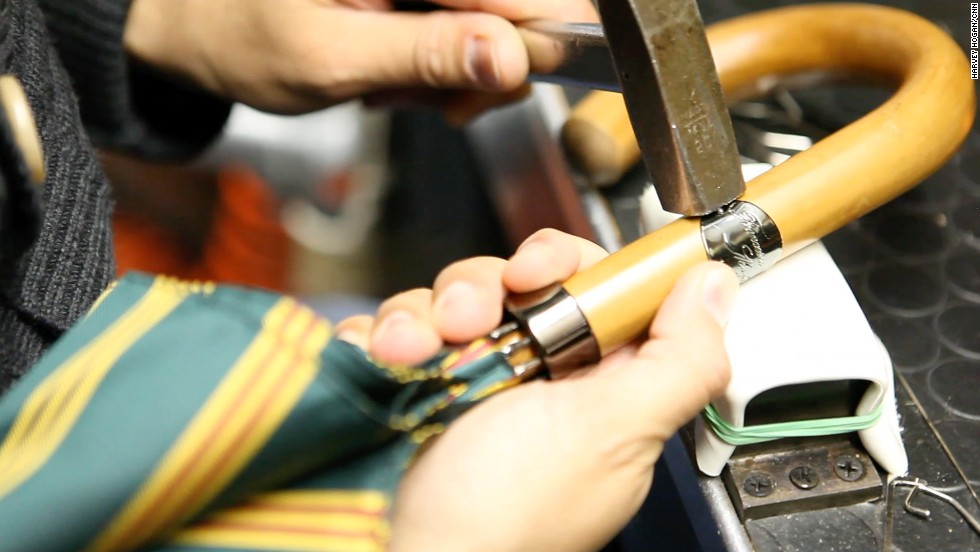
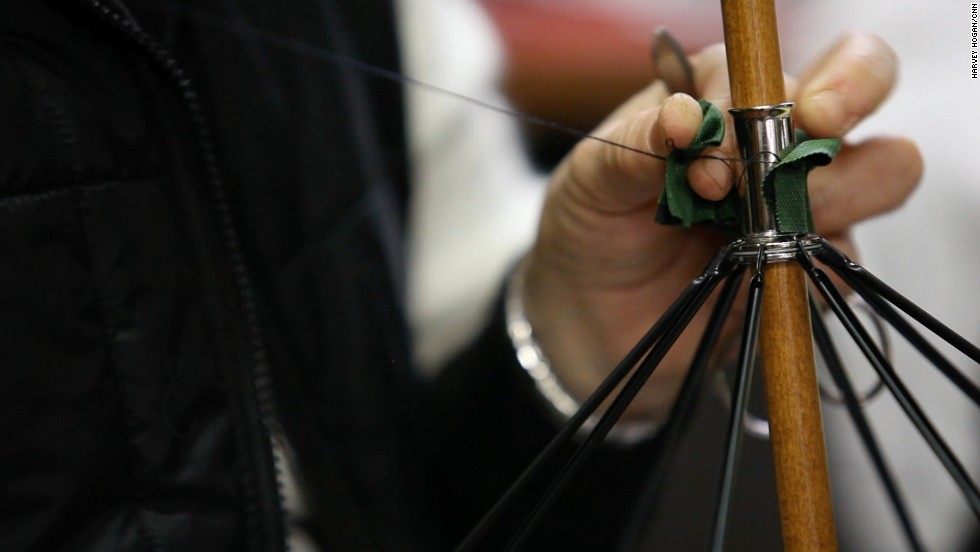
Every umbrella produced here is handmade using an 80-step traditional process.
They retail for more than $300.
Maglia decorates them in an "English style," either in plain colors or patterned with pinstripes, tartan or regimental stripes.
Each umbrella is produced from a single shaft of wood -- usually chestnut, ash, walnut or cherry, but more exotic Malacca cane and whangee bamboo are often used.
Only wooden shafts -- usually chestnut, ash, walnut or cherry.

Concerns for the future

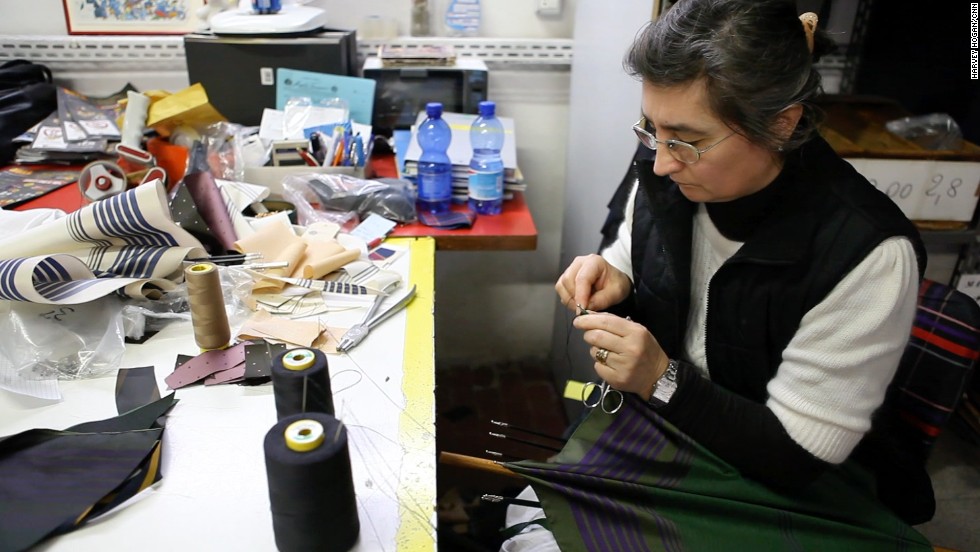
In the workshop, a small team of mostly female artisans works on one or two stages of the production.
"Our workers have been with us for 30, 40 years -- some of them will retire soon. It's like a big family," says Maglia.
While Francesco looks after the design and international sales (he speaks fluent German, French and English), his younger brother, Giorgio, supervises the production and sourcing of materials, which is increasingly becoming a challenge.
Every umbrella is made of about 25 parts and the number of the Italian suppliers have dwindled.
"It's hard to find suppliers that specialize in umbrella parts, especially metal ones like the ribs, which are the only parts produced in China at huge costs," says Giorgio.
The Maglias are one of only a handful of specialist manufacturers left.
Francesco is worried about the future of the craft in which his family has made its name.
"When I started we were 110 umbrella makers. Now for handmade umbrellas there are two, three, but the other five or six companies produce 80% in China and 20% in Italy.
"I am the biggest producer even if I am very small.
"In the early days we used to sell hundreds of umbrellas even here in Milan. Now people can buy one made in China for €5 ($6.75), so our umbrellas have become an item of luxury."
Many of the company's workers are nearing retirement age.

Two-handled umbrella?

Despite the challenges, both brothers still take pride in their work and enjoy experimenting with new materials.
They also make bespoke umbrellas -- even if the demands of their customers can at times be unorthodox.
"The clientele has changed a lot over the past few years," Giorgio says.
"Very recently someone asked us to make an umbrella with two handles -- one for him, one for her -- but there is only so much we can do with an umbrella."
Like many luxury products, the Maglias' business has managed to weather the financial crisis, winning over some of the world's most exclusive retailers and brands.
Today, the company produces about 25,000 umbrellas a year, of which 90% go to Maglia's international clientele -- mostly in Japan, Europe and the United States.
Now in his seventies, Francesco shows no signs of slowing down.
Holding up one of his favorite umbrellas, he breaks into almost predictable song.
"I'm singing in the rain, just singing in the rain. What a glorious feeling and I'm happy again."

Share:

World Sleep Day: 10 tips for a good night's sleep


How important is a good night's sleep?

How important is a good night's sleep? 07:21
Vital Signs is a monthly program bringing viewers health stories from around the world.
(CNN)With over 100 types of sleep disorders to contend with, and around 40-50% of us experiencing insomnia at some point in our lives, it's vital to keep an eye on your sleep habits and seek help if you need it, according to Antonio Culebras, organizer of World Sleep Day 2016, a global initiative educating the public about sleep.
Many of us don't even know the basic facts about sleep. For instance, it should take you 10 to 15 minutes to fall asleep, with seven to nine hours being optimal for most of us, ideally at a temperature of around 60-67°F (16-19°C).
Tired all of the time?

Tired all of the time? 07:58
To celebrate World Sleep Day we asked you to share your top tips for a good night's sleep on Twitter. You replied with loads of ideas, from drinking a soothing cup of camomile tea, to going to the gym, or having sex. Here are our favorite ones and what the experts have to say about them ...

1. Turn off your gadgets

This is a good strategy according to Russell Foster, director of Oxford University's SCNi (Sleep and Circadian Neuroscience Institute), as blue light emitted from smartphone, TV and computer screens can suppress melatonin (a hormone helping you sleep) and increase your alertness.
"What it probably will do is increase levels of alertness and therefore delay sleep onset ... it's a good rule of thumb to reduce light exposure," says Foster, advising to switch off your screens half an hour before bed and relax in a softly lit room.
You can even buy special light bulbs mimicking sunlight -- "white and color ambience" bulbs can gradually wake you up and send you to sleep by slowly brightening, dimming and alternating the light's frequency.

2. Avoid a bedtime tipple

However enjoyable nightcaps may be, unfortunately they could lead to more shallow sleep.
"Alcohol will actually disrupt some of the important things going on in the brain such as memory consolidation," says Foster.
A shallower sleep could lead to a negative cycle where you're dependent on sedatives to sleep, and stimulants such as caffeine or sugary food to stay awake during the day.

3. Get up early

If you're having trouble sleeping, getting up earlier could be the solution for you. It may seem brutal, but it can get results.
"Expose yourself to morning light as much as you can. That has been shown to stabilize the sleep/wake timing of the human body clock," says Foster.
You should also avoid napping, especially if it's for over 20 minutes, as waking up from deep sleep can make you feel even more groggy. By getting into a routine of getting up early and experiencing daylight your body clock adjusts to sleep earlier in the evenings, ridding you of those restless nights.

4. Forget your worries

Setting aside a quiet time in the evening to meditate, relax or pray was a popular response on Twitter.
It's important to let go of the worries that build up during the day as they can effect both the initiation and maintenance of sleep.
"The worries of the day should not be brought to bed," says Culebras, "A typical example here in the United States are people who work on their personal income tax and returns in bed ... of course they never match, so that's a typical thing that leads to insomnia."

5. Work out

Whether you're swimming, running, or practicing yoga, regular exercise can make for a great night's sleep.
It's best to work out around six hours before you go to bed as your body stays overheated for several hours after vigorous exercise, causing wakefulness.
"Exercise stimulates the nervous system, and it can cause insomnia if you exercise too late in the day," advises Culebras.

6. Work out a little more ...

For those of you with something a little spicier on your minds, sex was suggested as a good way to get a good night's sleep -- although bear in mind this could also be considered a form of exercise.

7. Have a hot drink

A hot (non alcoholic) beverage before bed is a great way to relax and prepare for sleep says Foster, as long as it doesn't contain caffeine.
"Try and wind down at least 30 minutes before you desired bedtime ... and go into a relaxed state, whatever that is for you -- it may be a hot milky drink, it may be reading a few pages of a novel."
Avoid coffee, chocolate and fizzy drinks at least six hours before you go to bed. Non caffeinated herbal teas are fine -- but don't drink too much or you may be making a midnight trip to the bathroom.

8. Listen to music

From soft new age sounds to gospel rhythms and sleep related podcasts, many of you drift off listening to music.
Soothing sounds can be a good way to doze off, but anything louder might have the opposite effect says Culebras.
"What is not as acceptable is loud rock and roll type music because that leads to excitation."

9. Only use medication as a last resort

While you may get results in the short term, it's important to be aware of unwanted effects and see your doctor if you're having trouble sleeping.
"Do not abuse medications to sleep ... if you need them for a short period always do it under the supervision of your physician, do not auto medicate yourself," advises Culebras.
"Eventually all of them have what we call rebound insomnia, which means once you stop them you are going to have two or three days with very little sleep at night."
Most of the time insomnia is triggered by psychological problems such as stress, anxiety or depression. It's important to see your physician and treat the underlying issues rather than use pills or supplements for immediate respite.
"We don't have this knee jerk reaction of giving a sleeping pill to everyone who suffers from insomnia," says Culebras. "We try to determine why, and then we try to remove what's causing or perpetuating insomnia."

Source--cnn.
Share:

Raid reunites trafficked tea plantation sisters

Delhi, India (CNN)Manju Gaur climbs the staircase with a fierce but steady determination. The building is decrepit, some walls crumbling, others caked in a thin, greasy film.
Just ahead of her is a row of police officers. Some from her native Assam state; others from this working class neighborhood in West Delhi.
A few steps behind her are a handful of social workers and coordinators from Bachpan Bachao Andolan, a local charity that has rescued thousands of children from human trafficking.
But Gaur -- a victim of trafficking herself -- is here on a much more personal mission: Finding her little sister.
Manju Gaur left her home village in rural tea-producing India to find her sister in Delhi.
Gaur was born in a rural village in Assam. Her parents worked on a tea plantation, one of hundreds scattered throughout the northern state, which produces more black tea than anywhere in the world.
Officially, tea workers in her village are supposed to earn around $2 U.S. a day, plus the equivalent of around $2 U.S more as in-kind services provided by their employer, like free housing, medical care, and primary education. With no advanced education and no hope of a better life, Gaur desperately wanted a way to help her parents make ends meet. Read the Tea Industry's full response to CNN's questions
She still remembers the day the agent came knocking on her door. She was just 14.
"One morning, he came to our house and said that he would put us to good work," she says.
The agent said he could arrange for Gaur to work for wealthy homeowners in Delhi where domestic servants are often employed to do everything from cooking to cleaning to looking after young children.
Tea workers earn less than $2 a day but few know how much it product sells for across the world.
Gaur says the agent lived in her own village and was well-known. She thought she could trust him.
"I was easily convinced" she says. "We're poor and live in a broken house without a rooftop. I thought I could earn and help my parents, and my sisters, so that we could study."
She was wrong.
In Delhi, she was kept in a house with other girls from Assam -- just like her -- all waiting to be sold as domestic labor. That's when she says the violence started.
"If the girls didn't listen," she explains, "they often hit them."
In one case, Gaur says the man who appeared to be the ringleader gave one of the girls a drink that rendered her nearly unconscious, and then took her to an empty room upstairs.
"She said that they got her too drunk and she couldn't do anything to stop him. I saw with my own eyes the number of girls they abused," Gaur says.
Manju guar shows off her home village in the tea picking Assam aera.
cfp trafficked for tea spc_00021427

Manju guar shows off her home village in the tea picking Assam aera. 04:26
Throughout the ordeal, Gaur says she was too afraid to report anything to authorities. For one, she was new to the city and didn't know anybody. And more importantly, she didn't have anywhere else she could go.
Police in Assam say young girls from tea plantations are easy targets. They live in poverty, have very little education, and their parents are often saddled with debt.
Most are descendants of the original bonded laborers brought in from other parts of the country by British colonial rulers. They live in the same circumstances as they did more than a century ago, with the same impoverished lifestyles.
Police say young girls see placement agencies as a way to escape the cycle, lured by promises of good jobs and a steady income. Instead, they often find themselves sold as domestic labor or forced to work in the sex industry. Police say hundreds of girls in tea districts fall victim to traffickers every year. In the worst cases, fathers sell their own daughters as a way to escape poverty.
After she realized what was happening, Gaur says she pleaded with the men.
"I tried telling them that I wanted to go home," she says. "But [the agent] said that they had already spent a lot of money on me, and that my family had to repay all of it before they could let me go. And so, I had to stay."
Final processing at the tea plant before it is shipped to market where prices rise or fall drastically.
She wound up being sent to a middle-class home, working as a domestic servant. There was no abuse, she says, but there was also no money. Her employers told her they sent her monthly salary directly to the placement agency. She never saw a single rupee. She says she worked around the clock, but never entertained the thought of leaving.
"I was new there and didn't know anyone," she says. "Who could I have possibly escaped with?"
After a year, Gaur says she mustered up the courage to explain her situation to a friendly neighbor, who gave her enough money for a train ticket back home. She didn't tell the homeowners she was going. She just took her things and left.
Gaur says life in her village in Assam is still better than working for the trafficker, but now she has another problem. Her sister, Aarti, has been lured away by traffickers. The last time Gaur spoke with her on the phone, she was in tears.
For help, Manju Gaur has turned to Bachao Bachpan Andolan, or the BBA. Its founder, Kailash Satyarthi, is a Nobel Peace Prize winner for his work in combating child labor and trafficking.
The BBA has arranged to bring Gaur to Delhi, where they've traced the trafficker's location to a non-descript apartment complex.
As police barge through the doors, calling out the trafficker by name, they have no idea what they'll find.
Gaur is led by police, room by room, asking if she recognizes anyone. She doesn't, and when they turn the corner to the next room, they find something that unfortunately is commonplace in raids like this.
India's tea producing heart is beautiful but poverty can drive tea workers into the arms of traffickers.
Three young girls, all huddled in a corner. They look frightened and shell-shocked. They tell police they're all from Assam, and that they were lured to Delhi by a man who said he worked for a placement agency. They say they were told he received 15,000 rupees -- just over $200 -- for each girl he brought in. But they haven't seen any money.
"He told us he gave my mummy the money," the youngest girl says.
Upstairs, police finally nab the trafficker, a man with a slight pot belly. When they bring him down, he appears unremorseful, insisting the girls came to Delhi of their own free will
Outside the police station, CNN Freedom Project confronts the trafficker with accusations that he was exploiting the girls
"They were not bought" he says. "We take a 35,000 (rupees) service charge for an 11-month agreement. Those who bring them from the village get 25,000 for an 11-month base.
"Some girls' husbands bring them. Some (girls') fathers bring them. They also get a commission.
Later, inside the police station, they prepare the formal charges, including bonded labor and cruelty to a child. While the suspect awaits, he cuts a deal with the police. He agrees to tell them where Manju's sister, Aarti, is working.
Two hours later, a smiling Aarti appears, accompanied by police. Gaur runs into her arms, with the kind of hug that only a loving sister can give.
Vijay Gaur, Manju and Aarti's father, says the offers from human traffickers can seem tempting.Vijay Gaur, Manju and Aarti's father, says the offers from human traffickers can seem tempting.
She knows there's a long road ahead. Aarti will be questioned by police and social workers, sent off to a nearby clinic for a mandatory health inspection, then spend weeks rehabilitating at one of the BBA's shelters for rescued children.
But still, for Manju, it's still a victory. Aarti is free. They're together again. For now, that's all that matters.
Source- edition.cnn.
Share:

ব্লগ সংরক্ষাণাগার

Recent Posts

Unordered List

Definition List